Permanent & Stable Replacement for Missing Teeth
Dental implants represent the modern gold standard in tooth replacement therapy. They restore missing teeth from root to crown, offering unmatched structural stability, natural chewing capacity, and facial shape preservation.
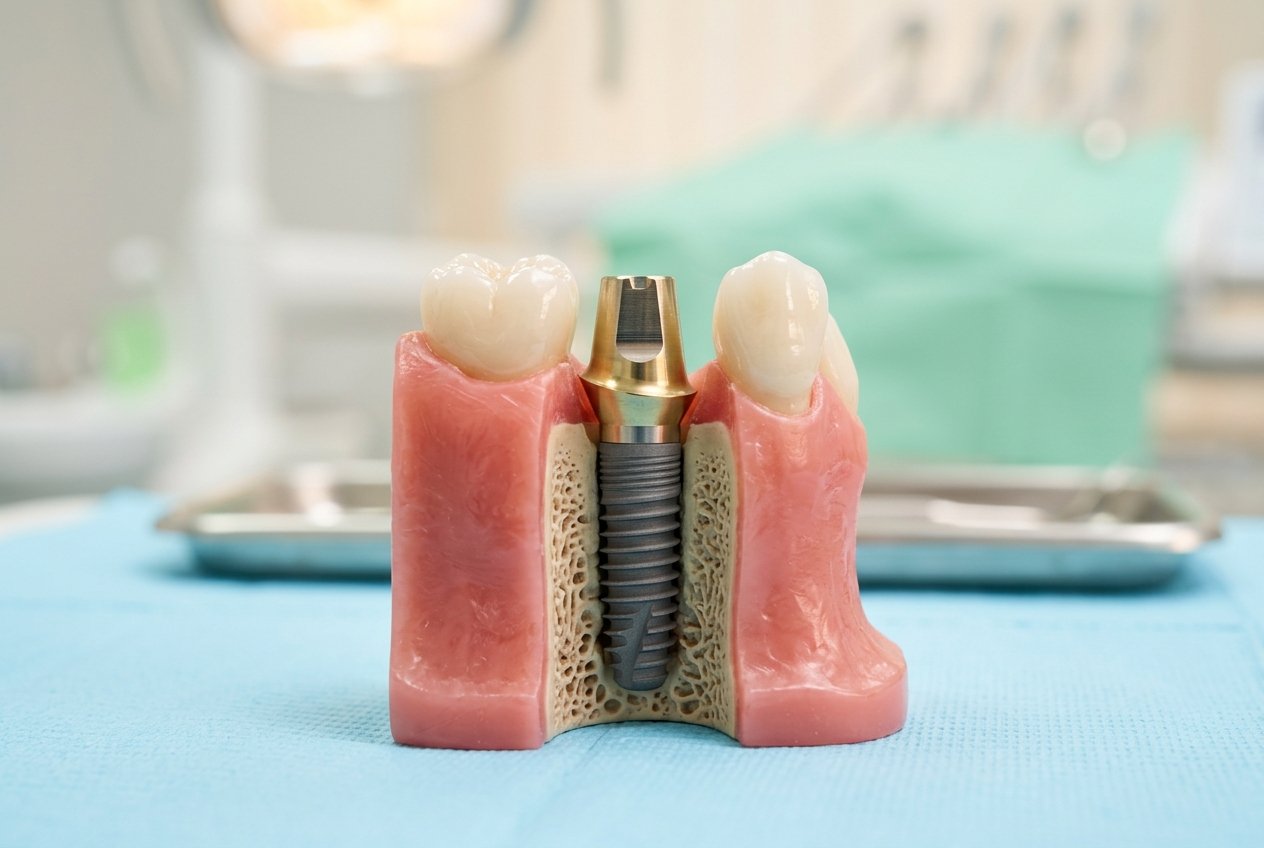
Unlike traditional dental bridges (which require grinding down healthy neighboring teeth) or removable dentures (which can slip or cause gum sores), a dental implant replaces the root structure itself. A medical-grade titanium fixture is anchored into the jawbone, where it undergoes osseointegration—fusing naturally with the bone over a few months to provide a permanent foundation for a custom ceramic or zirconia crown.
Anatomy of a Dental Implant
1. Implant Fixture
A bio-compatible titanium post surgically placed into the jawbone to act as an artificial tooth root.
2. Abutment Connector
A precision connector post attached to the implant fixture to securely hold the prosthetic crown.
3. Ceramic Crown
A custom-crafted zirconia or porcelain crown matched to your natural tooth shade and bite anatomy.
Comparing Tooth Replacement Options
| Feature | Dental Implants | Dental Bridges | Removable Dentures |
|---|---|---|---|
| Lifespan | Lifetime (with proper care) | 7 – 12 Years | 5 – 7 Years |
| Jawbone Health | Preserves jawbone density | Gradual bone loss underneath | Causes progressive bone loss |
| Adjacent Teeth | 100% Preserved (No grinding) | Requires reshaping adjacent teeth | Supported by gums / clasps |
| Chewing Force | 95% – 100% Natural bite force | 70% – 80% Natural bite force | 30% – 40% Natural bite force |
Step-by-Step Implant Timeline
Stage 1: 3D CBCT Evaluation & Planning
Dr. Bharati evaluates your jawbone density, nerve locations, and sinus positions using 3D digital scans to map exact implant placement coordinates.
Stage 2: Implant Fixture Placement
Under precise local anesthesia, the titanium fixture is positioned into the jawbone. The minor surgical procedure takes under an hour with minimal discomfort.
Stage 3: Osseointegration (3-4 Months)
Over the next 8 to 12 weeks, the bone cells integrate naturally around the titanium threads, creating a permanent structural bond.
Stage 4: Abutment & Crown Fitting
An impression is taken, and your custom zirconia or porcelain crown is permanently attached over the abutment, completing your smile transformation.
Implant Maintenance & Care
- Daily Cleaning Routine: Brush twice daily and use interdental brushes or water flossers around the implant crown to prevent peri-implantitis (gum inflammation).
- Avoid Tobacco Products: Smoking significantly impairs bone healing and reduces implant integration success rates.
- Regular Checkups: Schedule 6-month preventive cleanings so Dr. Bharati can verify bone stability and crown torque.
Frequently Asked Questions
No. Implant surgery is performed under local anesthesia, ensuring you feel zero pain during the procedure. Post-operative discomfort is mild and easily managed with prescribed painkillers for a few days.
Most adults with healthy gums and sufficient jawbone density are excellent candidates. For patients with bone loss, bone grafting options can be evaluated during your consultation scan.
Dental implants have a clinically documented success rate of 95% to 98% when placed by experienced dental surgeons under sterile conditions.